AMD Zen 6 Architecture Brings Major Microarchitecture Upgrades: 8-Width Instruction Dispatch and Continued SMT Support

Recently, @InstLatX64 shared an official AMD developer document on X, revealing significant microarchitectural changes in the upcoming Zen 6 architecture. The document, titled “AMD Family 1Ah Model 50h-57h Processor Performance Monitoring Counters”, does not list marketing specifications but offers a detailed glimpse into Zen 6’s internal design.
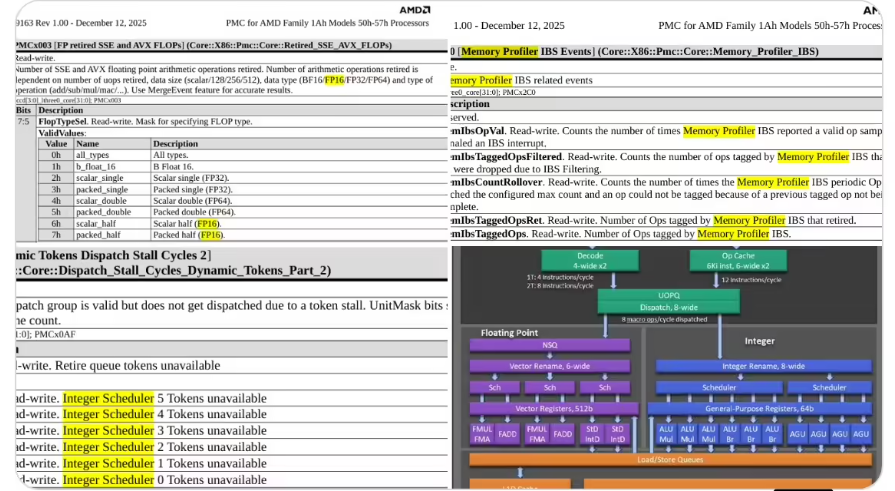
The most notable improvement is in the dispatch stage. Zen 6 adopts a wider 8-slot design, allowing the processor to dispatch more instructions to execution units per clock cycle, significantly improving parallel processing efficiency. The document also confirms that Zen 6 will continue to support Simultaneous Multithreading (SMT), enabling a single physical core to handle multiple threads concurrently, which enhances multitasking efficiency and reduces idle CPU time.
Moreover, AMD has greatly strengthened Zen 6’s vector and floating-point capabilities. The document shows support for 512-bit instructions, covering a variety of data types and extended instruction sets, including:
- VNNI (Vector Neural Network Instructions) for accelerating AI and deep learning workloads
- AES and SHA instructions for optimized encryption and hashing
These new performance counters allow developers to precisely monitor resource usage by threads, identify pipeline bottlenecks, and optimize application code. This indicates that AMD is positioning Zen 6 as a high-performance processor designed to handle scientific computing, media processing, and AI-intensive tasks, catering to the needs of future data-heavy applications.
At this time, AMD has not disclosed specific release dates, product naming, or desktop/server variants, and no benchmark data is included in the document. Nevertheless, the technical foundation already hints at Zen 6’s strong potential for parallel processing and computational performance.